What Is Moz Domain Authority? DA Meaning and Limits
What is Domain Authority, what does a good DA score mean, and how should Moz DA be compared? Learn its purpose, limits, and difference from Page Authority.
What Is Moz Domain Authority?
Domain Authority (DA) is a 1–100 score developed by Moz. It predicts how likely a domain is to rank in search results relative to competitors.
DA is not a score from Google and is not a direct ranking factor. It is a comparative model built from Moz's own link index and multiple factors. Backlink data—including linking root domains and link quality—plays a major role.
Check Moz DA and PA for one domain →
How Is Domain Authority Calculated?
Moz says its machine-learning model evaluates dozens of factors, primarily backlink data, to estimate the likelihood that a domain appears in Google search results. The exact model is proprietary and changes as Moz's index, training data, and model evolve.
Older summaries often list MozRank and MozTrust as if they are the complete current formula. Moz's current public definition instead emphasizes:
- Data from the Moz Link Explorer web index
- Linking root domains
- The quality and quantity of backlinks
- Multiple signals correlated with rankings across search results
- A machine-learning model that produces a relative score
Because DA is relative, a domain's score can change even when its own link profile appears stable. Other domains, Moz's index, and the model can all change.
What Is a Good DA Score?
Moz explicitly says there is no universal “good” or “average” DA. A score of 30 can be competitive in one niche and weak in another.
Use this process instead of fixed score bands:
- Identify domains competing for the same audience and search results.
- Compare all of them using the same provider and period.
- Inspect their actual ranking pages, referring domains, content, and technical quality.
- Treat DA as one relative input, not the decision.
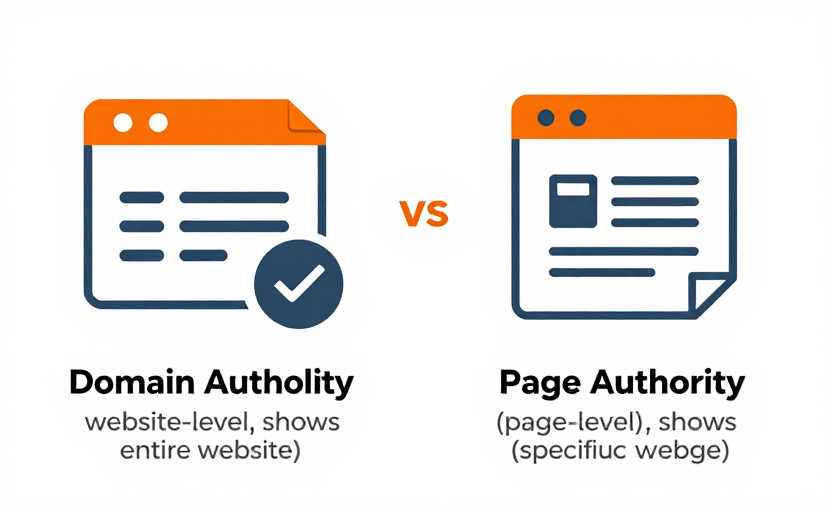
Domain Authority vs Page Authority
| Metric | Scope | Useful question |
|---|---|---|
| Domain Authority (DA) | An entire domain | How likely is this domain to rank relative to competing domains in Moz's model? |
| Page Authority (PA) | One specific page | How likely is this page to rank relative to competing pages in Moz's model? |
A domain can have a strong DA while a new or weakly linked page has a lower PA. Match the metric to the scope of the decision.
What DA Can and Cannot Tell You
DA can help with:
- Comparing relevant competitors
- Tracking a directional vendor metric consistently
- Prioritizing domains for deeper research
- Adding context to link and content-gap analysis
DA cannot tell you:
- Whether Google will rank a specific page
- Whether a backlink is editorial, relevant, or safe
- Whether content satisfies search intent
- Whether a site has a manual action
- Whether one fixed score is good in every industry
How to Check DA on DR Checker
The DA Checker currently accepts one public domain per request. It returns Moz DA, PA, and an available Moz Spam Score from the current third-party provider.
The checker does not currently provide Bulk DA/PA, export, scheduled monitoring, or score history. A provider failure appears as an error rather than a DA of zero.
For Moz's full link index, historical workflows, and bulk API, use Moz's own products.
How to Improve Domain Authority Responsibly
Do not optimize DA as an end in itself. Improve the underlying site:
- Publish original resources that relevant sites have a reason to cite
- Earn legitimate editorial links from additional relevant domains
- Maintain useful, crawlable content and clear internal linking
- Fix technical problems that prevent important pages from being discovered
- Compare actual search visibility and business outcomes, not only the vendor score
Do not buy ranking links, automate exchanges, or disavow links merely to manipulate DA. Google evaluates links with its own systems, independent of Moz.
For the full action framework, read the practical guide to improving Domain Authority.
DA vs DR vs TF
| Metric | Provider | Primary purpose |
|---|---|---|
| DA | Moz | Relative likelihood that a domain can rank in Moz's model |
| DR | Ahrefs | Relative strength of a domain's backlink profile |
| TF | Majestic | Backlink quality in Majestic's graph |
Different providers crawl different indexes and use different models, so one domain commonly receives different scores. None of these metrics is a Google ranking factor.
The complete side-by-side decision belongs in DA vs DR: which metric should you use?.
FAQ
Is DA a Google Ranking Factor?
No. DA is a Moz metric. Google does not read or use Moz DA as a direct ranking factor.
Is DA 20 or DA 40 Good?
There is no universal answer. Compare the score with relevant competitors using the same provider and period.
Why Did My DA Change?
Your links may have changed, other domains may have changed, Moz may have refreshed its index, or the model may have been recalibrated.
Does High DA Guarantee Rankings?
No. Page relevance, content, technical accessibility, competition, and many other factors still determine whether a page can rank.
Primary source: Moz's current Domain Authority documentation.