What Is Moz Website Spam Score? Meaning and Limits
What is Spam Score, and what does a good Spam Score mean? Learn how Moz Spam Score uses correlated features, why it is not a Google penalty, and how it differs from email spam.
What Is Moz Website Spam Score?
Moz Website Spam Score represents the percentage of sites with features similar to the researched domain that Moz found penalized or banned by Google in its training data. Moz says its machine-learning model identified 27 common features.
The result is correlation-based. It tells you to investigate; it does not say that Google has penalized the domain, that Google will penalize it, or that every link from the domain is harmful.
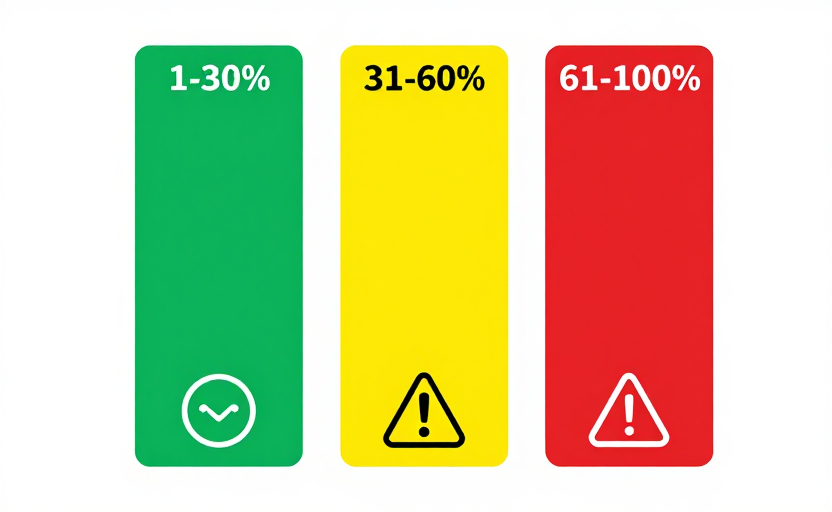
Moz groups results into three bands:
- 1% to 30% — Low
- 31% to 60% — Medium
- 61% to 100% — High
These are investigation bands, not probabilities of a Google penalty. A Low score does not certify a site, and a High score is not a spam verdict.
Check a domain's Moz Website Spam Score →
Website Spam Score vs Email Spam Score
This article covers an SEO website metric. It is unrelated to an email spam score, which evaluates a message, sender reputation, authentication, or delivery configuration to predict inbox placement.
| Metric | Subject | Intended use |
|---|---|---|
| Moz Website Spam Score | A researched domain | Prioritize a domain or linking-site investigation |
| Email spam score | An email message or sender | Diagnose delivery and spam-filter risk |
Adding “Moz Website” to the term matters because the short query spam score regularly mixes these two tasks.
How Is Moz Spam Score Calculated?
Moz uses a machine-learning model trained on known penalized and banned domains. It reports the percentage of sites with similar features that appeared in that set. Moz numbers the 27 features for reference, but says the numbering does not indicate importance.
That model does not establish causation. A legitimate site can share some correlated characteristics, and changing a feature solely to chase the score does not prove the site became safer or more useful.
Examples of Moz Spam Score Features
Moz's current help page lists features such as:
- A low number of pages found by its crawler
- TLDs that were correlated with spam domains in its data
- Domain-name length or numerals
- HTTPS, favicon, contact, or social-profile patterns
- Meta-keyword and title or description length patterns
- Unusually high or low external-link and linked-domain patterns
Some features are surprising. For example, a missing analytics or font integration can appear in Moz's historical correlation set. Do not add tracking libraries or make cosmetic changes solely to manipulate the score. Fix genuine user, security, content, or policy problems instead.
How to Use the Score
- Confirm the subject. Make sure you checked the intended root domain and did not confuse the result with an email score.
- Inspect the actual site. Review its content, ownership, contact information, topical relevance, and real visibility.
- Inspect the exact page or link. A site-wide score cannot describe the editorial context of every page or backlink.
- Look for independent evidence. Search Console manual actions, security warnings, obvious link schemes, or policy violations are more actionable than one vendor score.
- Document the decision. Record why you accepted, rejected, or monitored a site instead of using an automatic cutoff.
Important Misconceptions
Does a High Spam Score Mean the Site Is Spam?
No. It means Moz found a percentage of sites with similar features in its penalized or banned training data. It is a prompt to investigate, not a verdict.
Is Spam Score a Google Ranking Factor?
No. It is a Moz metric. Google does not use Moz Spam Score as a ranking factor or manual-action notice.
Does Disavowing Links Lower Spam Score?
Do not disavow a link solely because its domain has a high Spam Score. Moz recommends investigating the site's content and relevance first. Google says the disavow tool is for specific situations involving substantial unnatural links and a manual action or likely manual action; most sites do not need it.
Does the Checker Show All 27 Triggered Features?
No. DR Checker's free Spam Score page currently returns the domain-level percentage, DA, and PA when the provider supplies them. It does not return a per-feature breakdown. Use Moz's own products when you need its full investigation workflow.
Spam Score vs Domain Rating
| Metric | Provider | What it summarizes |
|---|---|---|
| Spam Score | Moz | Correlation among sites with similar features |
| Domain Rating (DR) | Ahrefs | Relative strength of a domain's backlink profile |
The same domain can have a high score on both, a low score on both, or any other combination. Checking both can suggest questions, but neither is a complete quality judgment or Google signal.
Check DR → | Check Moz Website Spam Score →
FAQ
What Is a Good Spam Score?
Moz labels 1%–30% Low, 31%–60% Medium, and 61%–100% High. These labels help prioritize investigation; they do not certify a domain or predict a Google penalty.
How Do I Reduce My Spam Score?
Investigate the site's real content, ownership, security, relevance, and link practices. Fix genuine problems, but do not add tracking libraries or make cosmetic changes solely to manipulate the number.
Is Spam Score the Same as DR?
No. Moz Spam Score is a correlation-based website metric. Ahrefs DR summarizes backlink-profile strength. They use different data and answer different questions.
Conclusion
Moz Website Spam Score is an investigation signal, not a verdict. Review the actual site and the specific link or partnership context before deciding.
Primary source: Moz's current Spam Score documentation.