What Is Ahrefs Domain Rating (DR)? How the DR Score Works
Learn what Ahrefs Domain Rating measures, how DR works, what a good score means, and why URL Rating (UR) can be higher or lower than DR.
What is Domain Rating?
Domain Rating (DR) is an Ahrefs metric that compares the strength of a website's backlink profile with other domains in the Ahrefs database on a 0–100 scale.
This follows Ahrefs' current definition of Domain Rating. DR is a vendor-specific, relative link metric—not a score published or used by Google.
DR is a relative score, and gains become harder toward the top of the scale. A site's score can move because its own links changed, because other domains gained links, or because Ahrefs refreshed its index and calculations.
Importantly, DR measures backlinks only. It does not factor in on-page SEO, content quality, or traffic. It answers one question: how strong is this domain's link profile?
Check your Domain Rating for free →
How is DR Calculated?
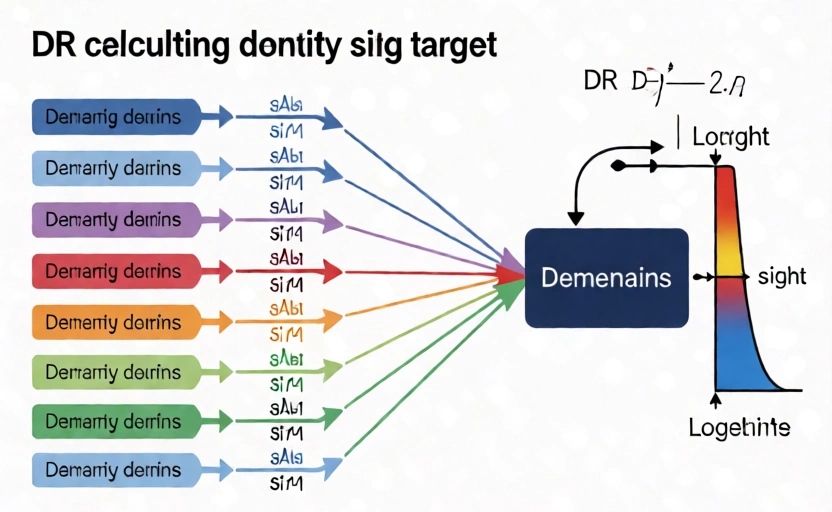
Ahrefs calculates DR using a roughly three-step process:
- Evaluate linking domains. Ahrefs considers the domains linking to the target and the strength of those domains.
- Account for outbound distribution. A source domain divides its influence among the unique domains it links to. A strong domain linking to thousands of sites may contribute less than its headline DR suggests.
- Repeat the graph calculation and scale the result. Ahrefs repeats the calculation through its link graph and maps the computed value to the 0–100 DR range.
Ahrefs does not publish every implementation detail. DR is best treated as a comparative summary of its link index, not a complete explanation of why a page ranks.
DR vs UR
Ahrefs has two commonly confused metrics:
| Metric | Scope | Useful question |
|---|---|---|
| Domain Rating (DR) | The domain's backlink profile | How strong is this domain relative to comparable domains? |
| URL Rating (UR) | One page's backlink profile | How strong is the link profile of this specific URL? |
Why Can UR Be Higher Than DR?
UR and DR are separate relative scales with different scopes, so UR does not have to sit below DR. A page on a lower-DR domain can earn unusually strong direct links and receive a higher UR than the site's DR.
Why Can DR Be Higher Than UR?
A page on a high-DR domain can have a low UR when few external sites link to that specific URL. The domain may have a strong overall backlink profile while the individual page has little direct link equity.
Rule of thumb: DR describes the site; UR describes the page. High DR with low UR can mean the domain is well linked while that page has few direct links. Low DR with high UR can happen when one page earns unusually strong direct links. Use the metric that matches the scope you are investigating, and do not compare the two numbers as if one must be higher.
What is a Good DR Score?
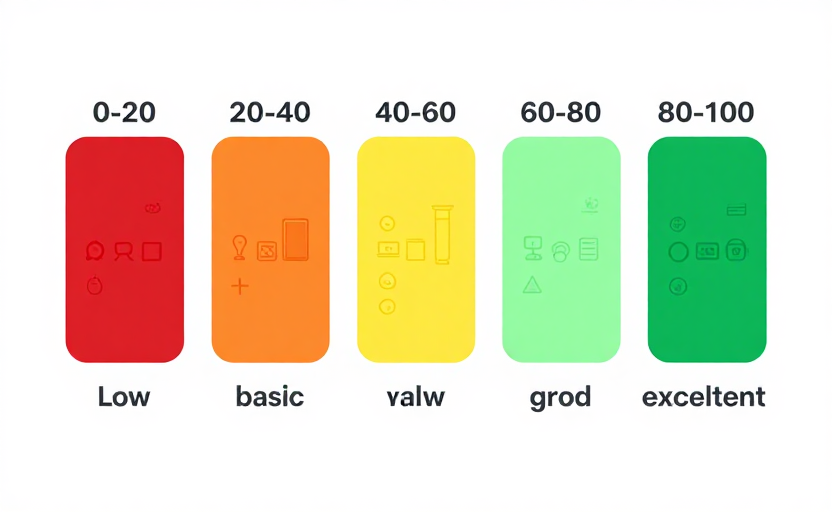
“Good” is relative to your niche and competitors. Ahrefs explicitly advises against treating 30, 50, 60, or 70 as universal good-score thresholds.
| Comparison | Interpretation |
|---|---|
| Below most relevant competitors | Investigate the referring-domain gap, but also compare content and actual visibility. |
| Similar to relevant competitors | The domain-level link profile is in a comparable range; page-level differences can still decide results. |
| Above most relevant competitors | The link profile may be stronger, but relevance, page quality, and search intent still matter. |
The right question isn't “is my DR good?”—it is “how does this observation compare with relevant competitors measured in the same provider and period?” Then inspect the actual ranking pages, page-level links, content, and search visibility before deciding what the difference means.
Check how your DR compares to competitors →
How to Increase Your DR
Because DR is based on the backlink graph, links from additional relevant domains are the main input you can influence. Tactics that may move DR include:
- Earn editorially relevant links. A source's DR is only a starting point; also inspect the linking page, topical fit, real audience, and outbound-link behavior.
- Diversify legitimate referring domains. Repeated links from the same source do not create the same domain diversity as independent editorial references.
- Create link-worthy content. Original research, data studies, free tools (like a DR checker), and comprehensive guides attract editorial links naturally.
- Do targeted outreach. Identify sites that link to competitors but not you, and pitch them your superior resource.
- Avoid manipulative link schemes. Buying ranking links or mass exchanges can violate Google spam policies regardless of whether a third-party score rises.
Patience is part of it. DR reflects the cumulative state of your link profile, so expect months, not days, between effort and movement.
DR vs DA vs TF
Three metrics are commonly used to assess a domain's authority. They come from different companies and measure different things:
| Metric | Maker | What it measures | Scale |
|---|---|---|---|
| DR (Domain Rating) | Ahrefs | Backlink profile strength | 0–100 |
| DA (Domain Authority) | Moz | Ranking potential (broader blend) | 1–100 |
| TF (Trust Flow) | Majestic | Trustworthiness of links | 0–100 |
They're complementary, not redundant:
- DR = how strong are the links (quantity + quality of referring domains)
- DA = how likely could this domain be to rank relative to competitors in Moz's model
- TF = how Majestic summarizes backlink quality
The same site can receive different scores because each provider has a different web index and model. Use the scores as vendor-specific comparisons, not as interchangeable Google signals.
Common DR Misconceptions
"DR is a Google ranking factor."
No. DR is an Ahrefs metric. Google has its own link algorithms and does not consult Ahrefs' DR. DR correlates with rankings because strong backlinks help both DR and organic rankings — but the causation runs through the links, not the DR number.
"DR equals traffic."
No. A site can have DR 60 and minimal traffic if its links point to pages that don't rank. DR measures link strength, not visitors. A niche site with DR 25 can out-earn a DR 60 site if it ranks for commercial keywords.
"DR can only go up."
No. DR can drop when links disappear, linking domains change, source domains link to more websites, Ahrefs refreshes its index, or the relative graph is recalculated. A drop without an obvious lost backlink is possible and is not evidence of a Google penalty.
"DR and DA are the same."
No — see the table above. They use different data, different algorithms, and measure different things. The same site routinely has different DR and DA. Read our full breakdown: DA vs DR: what's the difference?
How to Check Your DR
If you want to look up a score rather than learn how the metric works, use the free DR Checker. For screenshots, input rules, result interpretation, and Bulk mode, follow the dedicated step-by-step guide to checking DR.
FAQ
What is Domain Rating (DR)?
Domain Rating is an Ahrefs metric from 0 to 100 that measures the strength of a website's overall backlink profile. The more high-quality referring domains pointing to a site, the higher its DR.
What is a good DR score?
There is no universal good DR. Compare the score with relevant sites competing in the same niche and search results, then inspect page-level links, content, and visibility.
Is DR a Google ranking factor?
No. DR is an Ahrefs metric. It correlates with rankings because backlinks influence both, but Google uses its own algorithms, not Ahrefs' DR.
What's the difference between DR and DA?
DR (Ahrefs) measures backlink strength; DA (Moz) predicts ranking potential using a broader blend of signals. They use different data and algorithms, so the same site usually has different DR and DA. See DA vs DR.
Can URL Rating be higher than Domain Rating?
Yes. UR evaluates one URL and DR evaluates the domain. A page with unusually strong direct links can have a higher UR than its domain's DR because the metrics use different scopes and relative calculations.
Why did my DR drop if I did not lose backlinks?
DR is relative. Linking domains can change, source domains can add outbound links, Ahrefs can discover or remove data, and the provider can recalculate the graph. Inspect the underlying link report before attributing the movement to one cause.
How do I increase my DR?
Earn relevant editorial links from additional domains and create resources worth citing. Judge link opportunities by relevance, page quality, audience, and outbound-link behavior as well as DR.
How do I check my DR?
Use the free DR Checker for an immediate lookup, or follow the step-by-step DR checking guide for detailed instructions and result interpretation.